Aviratha’s ‘Science Beyond Sight’ Redefines Inclusive Learning in Bengaluru
Visually challenged students turn educators as Aviratha Trust and Deepa Academy showcas the power of tactile science education
 Chetan R @ vēritās news desk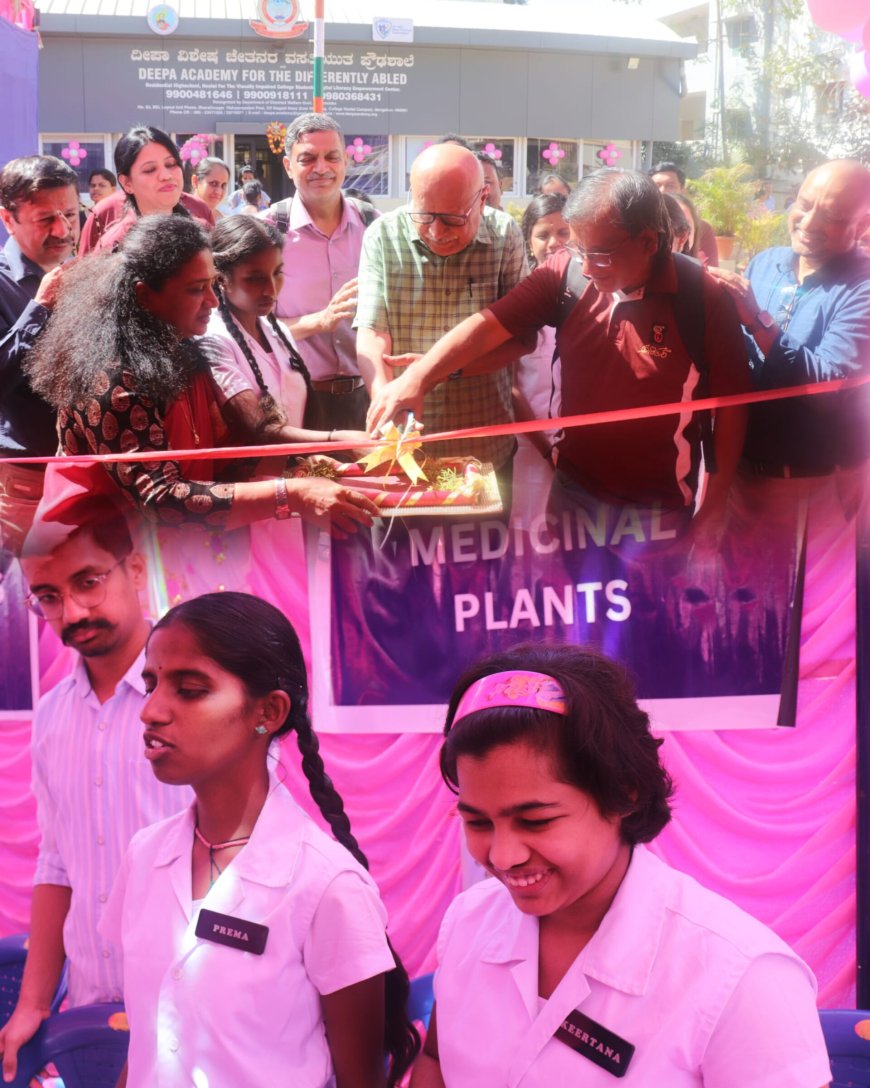
Bengaluru | Feb 15 :
In a quiet corner of Bengaluru, away from noise and headlines, a powerful lesson in courage, creativity and confidence was unfolding.
Inside Deepa Academy for the Differently Abled, students with visual impairment were busy explaining scientific concepts—not as learners, but as teachers.
The occasion was Science Beyond Sight, an exhibition curated by Aviratha Trust, which redefined how science can be taught, learnt and experienced beyond visual boundaries.
For these students, science was not written on blackboards or projected on screens. It was built, shaped and understood through touch, sound and reasoning.
When Classrooms Were Rebuilt
For nearly two months before the exhibition, Aviratha volunteers and mentors worked closely with students to redesign conventional science education.
Instead of printed diagrams, students worked with three-dimensional models. Instead of memorising formulas, they handled mechanisms. Instead of watching experiments, they conducted them.
Complex concepts—from basic physics to applied economics—were converted into tactile learning tools, making abstract theories accessible and meaningful.
The result was a classroom where curiosity replaced constraint.
Mentors Who Changed the Method, Not the Student
The initiative was led by Sreekanth Chakravarthy, Ramesh and Sunitha, with academic support from Ramachandra Bhat and Lakshmi Prasad Nayak. Student interns from BMS College of Engineering joined hands as learning partners rather than instructors.
Their focus went beyond academics. Students were trained to explain, question, defend ideas and interact with visitors—skills rarely prioritised in special education settings.
Confidence, not sympathy, became the core teaching principle.
From Learners to Leaders
On February 14, the training translated into action.
For over three hours, students independently handled the exhibition floor. They introduced models, demonstrated experiments and responded to queries with composure and clarity.
Visitors—parents, educators and citizens—found themselves learning from presenters who had once been considered “dependent learners”.
It was a powerful reversal of roles.
Redefining Inclusion
What made 'Science Beyond Sight' different was that it did not “accommodate” disability—it redesigned education itself.
Instead of adapting students to rigid systems, the programme adapted systems to human diversity.
The exhibition questioned a long-held assumption: that visual ability is essential for scientific learning. Aviratha’s model proved that understanding flows from engagement, not eyesight.
A Blueprint for Future Classrooms
Education experts who visited the exhibition noted that the initiative offers a scalable template for inclusive education.
By blending mentorship, innovation and empathy, the programme showed how mainstream and special education can converge.
It also highlighted the need for policy-level support to promote tactile learning tools and experiential pedagogy in public institutions.
Beyond Sight, Towards Self-Belief
As the exhibition concluded, one thing stood out—the students did not seek applause. They sought dialogue.
They did not display limitations. They demonstrated possibilities.
In a city known for technological innovation, Aviratha’s Science Beyond Sight delivered a deeper message: true progress lies in creating spaces where every mind can flourish.
On that February afternoon, science was not seen. It was felt. It was understood. And it was proudly owned.