A Life That Touched the Stars: Sunita Williams Retires After a Trailblazing Space Odyssey
Indian-origin NASA icon Sunita Williams signs off after 27 years of service, logging 608 days in space, nine spacewalks, and a legacy of resilience that inspired generations across the world.
 Chetan R @ vēritās news desk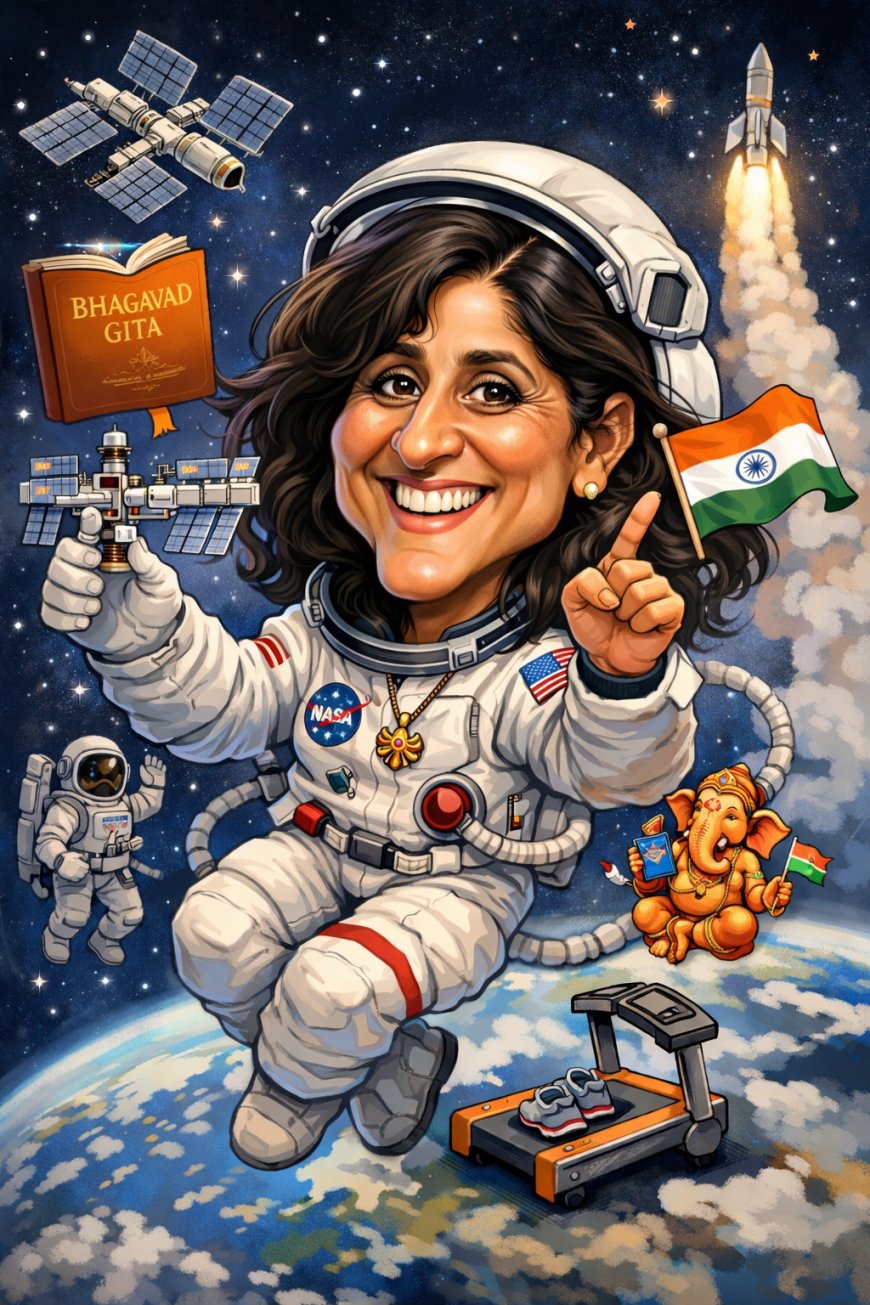
Bengaluru | Jan 21 :
After 27 years of service, NASA astronaut Suni Williams retired from the agency, effective Dec. 27, 2025, NASA state in its release.
Williams completed three missions aboard the International Space Station, setting numerous human spaceflight records throughout her career.
“Suni Williams has been a trailblazer in human spaceflight, shaping the future of exploration through her leadership aboard the space station and paving the way for commercial missions to low Earth orbit,” said NASA Administrator Jared Isaacman.
“Her work advancing science and technology has laid the foundation for Artemis missions to the Moon and advancing toward Mars, and her extraordinary achievements will continue to inspire generations to dream big and push the boundaries of what’s possible. Congratulations on your well-deserved retirement, and thank you for your service to NASA and our nation.”
As Sunita Lyn Williams finally signs off from active astronaut duty, she leaves behind far more than an extraordinary logbook of missions.
She retires with a legacy shaped by grit, grace, and quiet inspiration—one that transcends borders, cultures, and generations, and reminds the world what human perseverance looks like beyond Earth.
At the close of December 2025, NASA’s constellation of legends gained a defining chapter with the retirement of Williams, marking the end of a 27-year career that bridged oceans, orbits, and aspirations.
Roots of a Skyward Dream
Born on September 19, 1965, in Euclid, Ohio, Sunita Williams was raised in a home where curiosity was encouraged and limits were meant to be tested. She was the daughter of Dr. Deepak Pandya, a renowned Indian-American neuroanatomist from Gujarat, and Bonnie Pandya, of Slovene heritage. That dual legacy—scientific rigor and cultural rootedness—remained a lifelong anchor, one she carried symbolically and emotionally into space, becoming a role model for millions across India and the global diaspora.
Williams studied at Needham High School in Massachusetts before choosing an unconventional path, joining the United States Naval Academy, where she graduated in 1987 with a degree in Physical Science. She later earned a Master’s in Engineering Management from the Florida Institute of Technology, blending technical precision with leadership skills that would define her career.
Before Space, the Sea and the Sky
Long before she floated in microgravity, Williams proved her mettle closer to Earth. As a U.S. Navy helicopter pilot, she logged more than 3,000 flight hours across 30 aircraft types, serving in demanding operational roles, including humanitarian relief missions during Hurricane Andrew. Her calm under pressure, operational discipline, and adaptability would later become hallmarks of her astronaut life.
Reaching for the Stars
Selected by NASA in 1998, Williams underwent years of rigorous training before her first spaceflight in 2006, launching aboard Space Shuttle Discovery (STS-116) to the International Space Station (ISS). What was expected to be a routine long-duration mission soon turned into an extraordinary test of endurance.
During her Expedition 14/15 mission, technical and scheduling delays in the post-Columbia era kept her aboard the ISS far longer than planned. Williams ultimately spent 195 consecutive days in space, then a record for a woman astronaut.
Rather than viewing the extended stay as a hardship, she embraced it with characteristic resilience—conducting spacewalks, repairing station systems, exercising for nearly two hours daily to counter bone loss, and famously running the Boston Marathon on a treadmill in orbit, tethered as Earth spun silently below. Her steady adaptability became a case study in astronaut psychology and long-duration spaceflight readiness.
Breaking Records, Raising Bars
Williams returned to space in 2012 for Expedition 32/33, this time as Commander of the ISS, becoming only the second woman to lead the orbiting laboratory. By then, she had firmly etched her name into history.
Over the course of three space station missions, she accumulated 608 days in orbit, among the highest totals logged by any NASA astronaut. She completed nine spacewalks, totaling 62 hours and 6 minutes, setting records for women astronauts at the time. She also became the first person to run a marathon in space and a key contributor to ISS assembly, maintenance, and scientific research critical to future Moon and Mars missions.
Even in orbit, Williams carried pieces of home with her—a copy of the Bhagavad Gita, idols of Lord Ganesha, and the Indian tricolour—quiet affirmations of identity as she circled Earth nearly 400 km above the planet.
Final Mission and Farewell
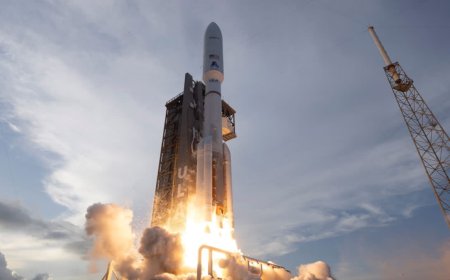
Her final spaceflight, originally planned as a short test mission aboard Boeing’s Starliner, turned into another prolonged challenge when technical issues extended her stay to over nine months. True to form, Williams handled the uncertainty with composure, returning safely to Earth in March 2025 aboard a SpaceX Crew-9 capsule.
More Than an Astronaut
Beyond records and missions, Sunita Williams became a bridge—between science and society, between India and the United States, between young dreamers and distant stars. She visited India multiple times, inspired students and scientists, and spoke candidly about perseverance, teamwork, and embracing failure as an essential part of exploration.
On one visit, she recalled that the first thing she did after reaching space was to look down at Earth to locate the homelands of her parents—India and Slovenia—a quiet, poetic reminder of human unity in the vastness of space.
Legacy of Courage
As she retires, Sunita Williams does not step away as someone who merely “went to space.” She leaves as someone who expanded humanity’s comfort zone, showing that leadership can be calm, courage can be quiet, and endurance can even be joyful.
In the vast silence of space, Sunita Williams taught the world how to listen—to discipline, to curiosity, and to the infinite possibilities that await those brave enough to look up.